



Article: The Optimal Red Light Therapy Dosage for Skin: A Complete Guide
The Optimal Red Light Therapy Dosage for Skin: A Complete Guide
- 01Red Light Therapy Dosing Explained: Power, Time, and Energy
- 02Why Dosage Matters for Skin Collagen?
- 03How to Calculate Your Red Light Therapy Dosage?
- 04The Biphasic Dose Response Curve: Finding the Red Light Sweet Spot
- 05How Red Light Therapy Dosing Changes for Different Body Areas
- 06Does a Higher LED Light Count Mean a Better Device?
- 07Red Light Therapy Wavelengths: Penetration Depth & Targeted Benefits
- 08Other Key Factors That Influence Your Treatment Results
Achieving glowing, youthful skin with red light therapy comes down to hitting the therapeutic sweet spot: 5 to 9 Joules per square centimetre (J/cm²). Because your required session time depends directly on your device's power output, you can easily calculate your exact treatment time using the simple formula below or follow your manufacturer's directions for effortless, consistent results.
Red Light Therapy Dosing Explained: Power, Time, and Energy
To understand how red light therapy works, think of light as cellular food. Dosing simply means delivering the exact right amount of light energy to your skin cells.
Three basic factors determine your dose:
- Power (Irradiance): How strong or intense the light bulbs are.
- Time (Seconds): How long you keep the light on your skin.
- Energy (Fluence): The total amount of "light food" your skin receives by the end of the session.
If your light is strong, you need less time. If your light is gentle, you need more time. High-quality devices use more bulbs that are densely packed and overlap for better coverage. So does more power mean better? The quick answer is no, but let's find out why.

Why Dosage Matters for Skin Collagen
Your skin cells contain tiny power generators called mitochondria. As we age, or suffer damage from stress and sunlight, these generators slow down. This causes the skin to lose collagen, leading to fine lines, wrinkles, and slow healing.
Red light therapy acts like a charger for these cellular generators, boosting their ability to produce ATP (cellular fuel). When your cells have enough fuel, they naturally produce more collagen and elastin, keeping your skin firm and youthful.
- Low Dose: The generators don't turn on, and you won't see any changes in your skin.
- High Dose: The cells get overwhelmed and temporarily shut down, halting your progress.
- Optimal Dose: Your cells get energized, speeding up collagen production and skin repair.
How to Calculate Your Red Light Therapy Dosage? (Formula & Example)
You don't need to be a mathematician to track your light dose. The total energy hitting your skin (measured in Joules) is simply Power × Time.
The Easy Formula
Dose (J/cm²) = Power (mW/cm²) X Time (seconds) / 1000
Example: If a device has a power strength of 30 mW/cm² and you use it for 3 minutes (180 seconds):
Multiply power by time: 30 (mW/cm²) X 180 (seconds) = 5400
Divide by 1,000: 5400/1000 = 5.4
Therefore the total dose is 5.4 J/cm², which is the perfect therapeutic amount for daily skin care.
The Biphasic Dose Response Curve: Finding the Red Light Sweet Spot
In red light therapy, more power is not always better. Light therapy follows a rule called the biphasic dose response—a fancy way of saying there is an “Optimal Dose”.

- Low Dose (<5 Joules): The light is too weak or the session is too short to wake up your cells.
- Optimal Dose (5-9 Joules): The ideal window where skin cells repair damage and produce collagen at peak levels.
- High Dose (>10+ Joules): The cells get flooded with light, wiping out the beneficial effects.
Your ideal treatment time depends entirely on your device’s power output. While high-powered devices can deliver a full dose in just 3 to 6 minutes, lower-powered devices require longer sessions. Keep in mind that balance is key—light that is either too intense or too weak will have little to no effect on your cells. Above all, consistency matters far more than sporadic, lengthy sessions. You can calculate your exact session time using the formula above, or simply follow your device manufacturer's guidelines for optimal results.
How Red Light Therapy Dosing Changes for Different Body Areas
The 5-9 Joules rule works perfectly for delicate skin on the face area, but your required dose changes depending on which part of the body you are targeting. Different skin thickness, target depth, and treatment goals require different joules to see meaningful improvement.
- Face & Neck: Skin here is thin and delicate. A lower dose of 5–9 J/cm² is what is required to stimulate collagen, reduce fine lines, and calm redness.
- Joints, Muscles, Legs & Deeper Tissue Repair: Treating deeper targets such as knees, shoulders, thighs, or back muscles requires light to travel through skin, tissue (fat), and dense muscle layers. To ensure enough light energy penetrates down into these deep cellular structures, a higher dose of 50-70 J/cm² is required, depending on tissue depth and severity.
Matching the dose to the depth of the target tissue ensures facial skin never gets overwhelmed, while deeper muscle and joint targets receive enough energy to support recovery.

Does a Higher LED Light Count Mean a Better Device?
Not all light therapy devices deliver light evenly across your skin. The secret to consistent and even results lies in LED density and beam overlapping.
Eliminating "Untreated Areas": When the LED bulbs are spaced far apart or there are just not enough of them, the light beams don't touch. This leaves areas on your skin that receive zero energy and are left untreated.
- Overlapping LEDs: High-density devices place hundreds of LEDs close together so their light cones cross paths. This ensures every millimeter of your face gets an identical therapeutic dose.
- More Even Results: Overlapping light guarantees that your cheeks, forehead, and jawline build collagen at the exact same rate, preventing patchy skin improvements.

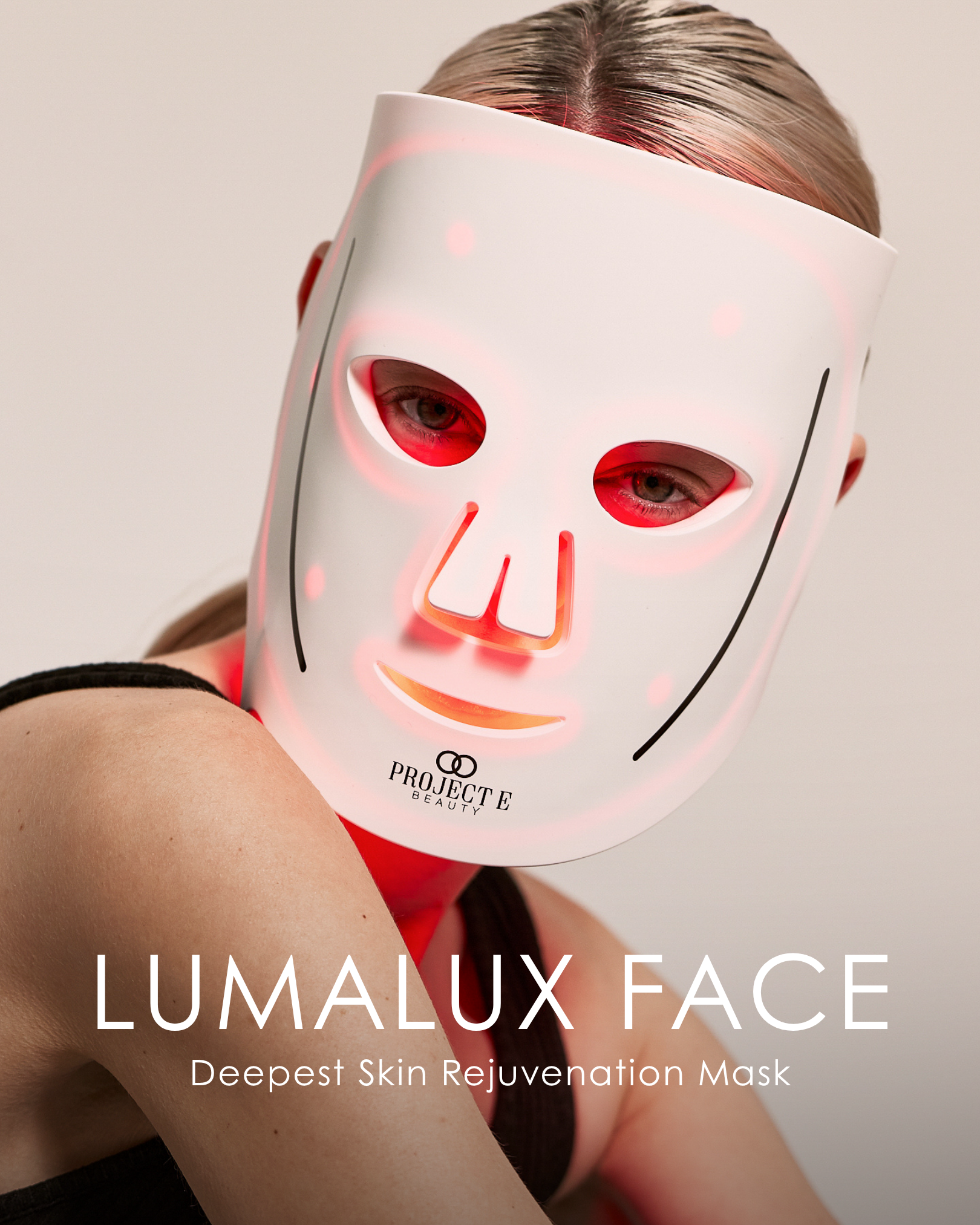
This is why it is essential to choose a device from a trusted brand, like the Lumalux Face by Project E Beauty. Designed specifically with optimal coverage in mind, it features 800 high-grade LEDs 400% more than the industry average to thoroughly treat all areas of the face and eliminate untreated cold spots while safeguarding the eyes with integrated protective covers.

Red Light Therapy Wavelengths: Penetration Depth & Targeted Benefits
Light travels in different wavelengths with each color reaching a different layer beneath your skin to treat specific concerns:
| Light Color | Wavelength Range | Depth | Best For |
| Blue Light | ~460 nm | Surface | Targets and kills blemish-causing bacteria and regulates oil |
| Green / Yellow Light | ~520 – 590 nm | Shallow | Helps fade dark spots, reduce redness, and calm sensitivity |
| Red Light | ~630 – 660 nm | Deep-Skin | Stimulates collagen, smooths wrinkles, and supports overall anti-aging |
| Near-Infrared Light | ~850 – 1072 nm | Deeper Skin | Penetrates deepest to support static wrinkles and deep tissue |
Other Key Factors That Influence Your Treatment Results
Dosing, Density & Wavelengths are critical, but several real-world factors determine how well light therapy works for your daily routine:
- Mask Fit & Contouring: Both flexible materials (like medical-grade silicone that molds directly to your facial curves) and high-quality hard-shell masks deliver excellent results, as long as they hold the LEDs at a consistent, optimal distance from your skin without leaving gaps.
- Consistency Over Intensity: Doing 3–5 short sessions per week produces dramatically better long-term collagen results than doing one long session once a month.
- Skincare Synergy: LED light therapy works best alongside a supportive routine. Protect your progress by wearing daily sunscreen and applying hydrating serums after your treatment.
While many factors influence your red light therapy results, device selection ultimately hinges on LED density and correct power density. Investing in an advanced, high-density device and sticking to recommended treatment times ensures your skin cells receive the exact energy required for safe, effective collagen production and targeting your main concerns.


Leave a comment
This site is protected by hCaptcha and the hCaptcha Privacy Policy and Terms of Service apply.